 Site Diary
 › Toolbox talks
Toolbox talk topics for South African sites
37 free toolbox talks, written for South African building sites and the law that applies to them. Each one is a talk you can read out in five to ten minutes, things to check on site today, questions for the crew, and a printable A4 PDF with its attendance register.
What is a toolbox talk?
A toolbox talk is a short safety talk given on site, usually at the start of the shift, about one hazard the crew will meet that day: working at height, an open trench, dust, a new machine, the heat. The name comes from gathering round the toolbox before work. It isn't a lecture: the supervisor talks for a few minutes, points at the real thing on site, asks questions and listens. Then everyone signs an attendance register.
Good talks are short, about this site and today's work, and in a language the crew understands. A talk on ladders means more when you are standing next to the ladder.
Are toolbox talks required by South African law?
The law doesn't use the words "toolbox talk". What it requires is that workers are told about the hazards of their work, instructed and trained in how to work safely, and supervised. A toolbox talk with a signed register is the usual way a site does that every day, and shows that it was done.
- Occupational Health and Safety Act 85 of 1993, section 8(2)(e) and (i)Every employer must provide the information, instructions, training and supervision needed to keep employees healthy and safe at work, as far as reasonably practicable, and make sure work is done under the general supervision of someone trained to understand its hazards.Read on 21 November 2026
- Construction Regulations 2014, regulation 9(3)A contractor must make sure that every employee under their control is informed, instructed and trained by a competent person about each hazard and the work procedures or controls for it, before work starts and then at the times set in the site's risk assessment.Read on 21 November 2026
- Construction Regulations 2014, regulation 7(5) and 7(1)(b)Nobody may enter a construction site without health and safety induction training on the hazards there at the time. Contractors must keep a health and safety file on site with all the documentation the Act and the Regulations require.Read on 21 November 2026
- Occupational Health and Safety Act 85 of 1993, section 14Workers must take reasonable care of themselves and others, follow the site's health and safety rules, and report unsafe situations and incidents, at the latest by the end of the shift for an incident.Read on 21 November 2026
This is general information, not legal advice. Your principal contractor's health and safety plan and your risk assessments may set how often talks are given and what records are kept. The links go to the Acts Online copies of the Act and the Regulations.
How to give a toolbox talk in five to ten minutes
- Pick the topic from today's work. What is the riskiest thing the crew will do today? Talk about that, not about whatever is next on a list.
- Print the talk and the register, or have the page open on your phone. Read it through once before the crew arrives.
- Gather everyone where they can hear you, away from running plant, and close to the hazard if it is safe.
- Say it in your own words, in the language the crew understands best. Ask someone to translate if you need to.
- Point at the real thing. Walk over to the trench, the scaffold or the extension lead and show what good looks like.
- Ask the questions and listen. The crew often knows about a problem before the supervisor does. Fix what you can on the spot.
- Get the register signed by everyone who was there, and sign it yourself as the presenter.
- Keep the record. File the register in the site's health and safety file, and log the talk in your site diary.
Safety topics for daily toolbox talks
Every talk is free, with a printable PDF and its register. Pick by today's work.
- Protective equipment
- Work at height
- Tools and plant
- Excavation and structures
- Health
- Fire and electricity
- Site order
- People and emergencies
- Weather and environment
Protective equipment
- Eye and face protectionGrinders, disc cutters, chisels, nail guns, wire brushes, welding, cement and chemicals all threaten eyes on a building site, and many eye injuries come from a single chip or splash that takes less than a second.5 min · talk + register PDF
- Hand safety and glovesBuilders use their hands for almost everything: carrying blocks, tying steel, stripping shutters, handling sheet metal and glass, and running grinders and breakers.5 min · talk + register PDF
- PPE: personal protective equipmentPPE is the last thing standing between a worker and an injury when everything else has failed.5 min · talk + register PDF
Work at height
- LaddersLadders are cheap and always close by, so they get used for jobs they were never meant for and in a condition they should never be in.5 min · talk + register PDF
- Roof work and fragile roofsA roof puts an edge, a slope and a surface that may not hold you all in one place.5 min · talk + register PDF
- ScaffoldingA scaffold carries people, bricks and mortar above the ground, so when it is badly built, overloaded or quietly changed by someone who needed a board, it can collapse or let a person fall.5 min · talk + register PDF
- Working at heightsFalling is one of the quickest ways to be killed or crippled on a building site, and on small jobs the danger is usually an open slab edge, a stairwell with no rail or a hole in the floor, not a tall tower.5 min · talk + register PDF
Tools and plant
- Construction vehicles and mobile plantTLBs, tipper trucks, rollers, dumpers and delivery trucks share small sites with people on foot.5 min · talk + register PDF
- Cranes, slings and lifting loadsWhen a crane or hoist lifts roof trusses, steel, precast or a skip of bricks, a broken sling, a badly hooked load or a crane on soft ground can drop tonnes onto the people underneath.5 min · talk + register PDF
- Power tools and angle grindersAngle grinders, circular saws, drills and breakers are on every site, and they cause deep cuts, eye injuries, burns and electric shocks.5 min · talk + register PDF
- Transporting workers and loads by bakkie or truckMany small crews get to site in the back of a bakkie or truck, often with spades, wheelbarrows and a mixer in the same load bin.5 min · talk + register PDF
Excavation and structures
- Confined spacesSmall builders and plumbers in South Africa regularly work in manholes, sewer connections, septic and conservancy tanks, water tanks, sumps, deep pits and crawl spaces.5 min · talk + register PDF
- Demolition workDemolition takes away the parts that hold a building up, so a wall, slab or roof can come down before anyone expects it.5 min · talk + register PDF
- Excavations and trenchesSoil is heavy, and a trench wall can fall in with no warning and bury a worker before anyone can dig them out.5 min · talk + register PDF
Health
- Alcohol and drugs on siteA building site has heights, open edges, plant, power tools and live electricity, and a person under the influence puts the whole crew at risk, not only themselves.5 min · talk + register PDF
- Asbestos awarenessMany older South African buildings still have asbestos cement roof sheets, gutters, downpipes, ceilings, fascias and water tanks.5 min · talk + register PDF
- Dust and silicaConcrete, bricks, blocks, tiles, mortar, sand and stone all contain silica.5 min · talk + register PDF
- Fatigue and long shiftsOn many South African sites the day starts with a long taxi or bakkie ride before sunrise and ends with the same trip home, and deadlines push crews into overtime and weekend work.5 min · talk + register PDF
- Hazardous chemicals and safety data sheetsBuilding sites use a lot of chemicals: solvents, primers, waterproofing, adhesives, form oil, acids for cleaning brickwork, paint and fuel.5 min · talk + register PDF
- Heat stress and working in the sunOn a South African summer site the crew works in full sun on roofs, slabs and open ground, often doing hard physical work.5 min · talk + register PDF
- Lifting and carrying by handOn a building site we lift and carry all day: cement bags, blocks, kerbs, steel, shutters and full wheelbarrows.5 min · talk + register PDF
- Noise and hearing protectionBreakers, disc cutters, compactors, concrete vibrators, nail guns and generators are loud enough to damage hearing.5 min · talk + register PDF
- Wet cement and concrete burnsMixing mortar, casting slabs, plastering and screeding put cement on hands, knees and feet every day on a South African site.5 min · talk + register PDF
Fire and electricity
- Electrical safety on siteA building site is hard on electrical gear: leads get driven over, cut by sheeting, soaked in rain and patched with tape.5 min · talk + register PDF
- Fire prevention and fire extinguishersA building site is full of things that burn: offcuts, cardboard, plastic wrap, paint, thinners, diesel and gas.5 min · talk + register PDF
- Gas cylinders (LPG, oxygen and acetylene)Small sites use gas every day: LPG for heaters, torches and waterproofing, and oxygen with acetylene for cutting and brazing.5 min · talk + register PDF
- Hot work: welding, cutting and grindingWelding, gas cutting and grinding throw sparks and hot metal that can land in timber, insulation, rubbish or waterproofing and smoulder unseen until long after the job is done.5 min · talk + register PDF
Site order
- Housekeeping: a tidy, safe siteOffcuts, loose blocks, nails in old shuttering and hoses across walkways cause trips, cuts and puncture wounds on sites every week.5 min · talk + register PDF
- Site traffic, deliveries and keeping the public safeSmall sites are often squeezed onto a residential plot or a busy street, so delivery trucks, tippers, bakkies and plant share the same space as workers, neighbours, children and passers-by.5 min · talk + register PDF
- Slips, trips and fallsFalling on the level sounds minor, but on a building site you land on concrete, rebar, rubble and tools.5 min · talk + register PDF
- Stacking and storing materialsBricks, blocks, cement bags, steel, pipes and timber arrive on site in heavy loads.5 min · talk + register PDF
People and emergencies
- First aid and emergenciesBuilding sites are often far from a hospital, and an ambulance can take time to find a new address with no street number.5 min · talk + register PDF
- New on site: induction and visitorsNew people on a site do not yet know where the hazards, the exits and the first aid box are.5 min · talk + register PDF
- Reporting incidents and near missesEvery serious injury on site is usually preceded by near misses that nobody mentioned.5 min · talk + register PDF
Weather and environment
- Lightning and thunderstormsThe South African Weather Service warns that lightning is a real and serious danger, particularly in the eastern half of South Africa, one of the most lightning-prone countries in the world.5 min · talk + register PDF
- Snakes, bees and scorpionsSouth African sites on new stands, farms and the edges of towns regularly turn up snakes, bee swarms and scorpions in stacked material, rubble, long grass and pipes.5 min · talk + register PDF
- Spills, waste and dust: looking after the environmentA few litres of diesel, oil or cement wash water poured into a storm water drain end up in a river, and rubble dumped on an open plot is illegal dumping.5 min · talk + register PDF
The attendance register
Every talk's PDF has its own register on page 2, with the topic filled in. For your own topics, print the blank register: topic, site, date, time, presenter, and 22 numbered rows for name, company or trade, and signature.
Site Diary, for Android
Log the talk in today's site diary
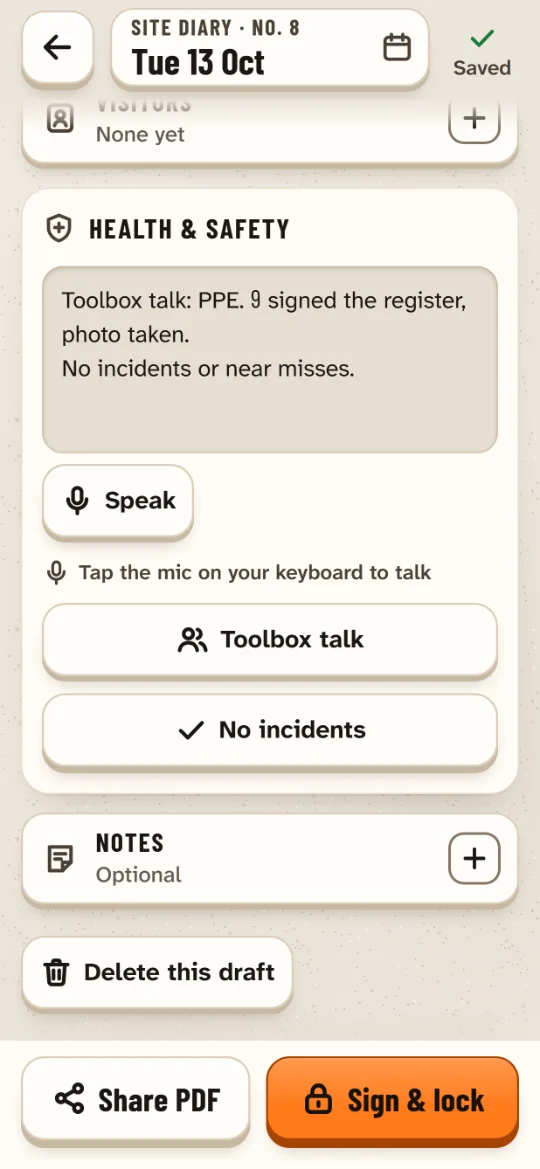
Site Diary is a daily site record for builders and subcontractors. Its Health & safety section is where the day's toolbox talks, incidents and near misses go.
- Tap Toolbox talk and pick from twelve common topics, or type your own.
- Take a photo of the signed register: it's stamped with the date, time and GPS position.
- Sign the day and it locks. The day's PDF shows the talk and the photo.
Free for 2 months from your first diary day. No card, no account. More about the app.
Toolbox talk questions
What is a toolbox talk?
A short, informal safety talk given on site before work, usually by the supervisor or foreman, about one hazard the crew will face that day. It takes five to ten minutes, and everyone who attends signs a register.
Is a toolbox talk a legal requirement in South Africa?
The words "toolbox talk" aren't in the Occupational Health and Safety Act or the Construction Regulations 2014. But employers must give workers the information, instructions, training and supervision they need (section 8 of the Act), and contractors must inform, instruct and train workers about each hazard before work starts (regulation 9(3) of the Construction Regulations). A toolbox talk with a signed register is the common way to do it and show it was done.
How often should toolbox talks be held?
Many sites hold one every day or every week, and always before a new or high-risk task starts. The Construction Regulations tie the timing to the site's risk assessment, so check what your health and safety plan says.
Who should give the toolbox talk?
Usually the site supervisor, foreman or safety officer: someone who knows the work and the hazards, and who the crew listens to. Regulation 9(3) of the Construction Regulations says the instruction must come from a competent person.
What should a toolbox talk register include?
The topic, the site, the date and time, the presenter's name and signature, and for each person who attended: their name, their company or trade, and their signature. Our free register has all of these.
What language should the talk be in?
The language the crew understands best. The point of the talk is that people understand the hazard and what to do about it, so use a translator on the crew if you need one, and keep the words simple.
Can I use these talks on my site?
Yes, they're free to print and use on your own sites. Adapt them to your work: they're general information, and your site's risk assessment and safety plan come first.